Sunday, August 26, 2012

Intellectual Dishonesty, Or Why Heavy Objects are Dark


In this post, I'd like to address what is intellectual dishonesty and why motivates others to engage in it. (It's never us, right? Right?) What I won't do is list forms of intellectual dishonesty. While this can be fun, there are lots of websites that do this. Here are some links to a few of them: Obligatory Wiki link on Intellectual Honesty; another blog on honesty; same blogger on dishonesty; a nice list of forms of dishonesty; and, a list of fallacious arguments.

It perhaps goes without saying that intellectual dishonesty is the opposite of intellectual honesty. Perhaps it is worth noting why the term exists at all. That is, why do we use the term intellectual dishonesty rather than simply dishonesty. When people are dishonest, they are dishonest about why they are late to work or who broke the vase in the living room. Dishonesty is lying to protect one's interests whether we perceive those interests rightly or wrongly. Honesty is valuing truth above one's interests, or perhaps finding truth one's single best interest.

These basic definitions provide a starting point on the subject of intellectual dishonesty. Intellectual honesty is valuing truth even to the point of risking one's most cherished beliefs. It is being able to follow a discussion to its bitter end with regard only for truth. Intellectual dishonesty, then, is the avoidance of the truth. (The above links catalog the various ways in which this is done.) I think why we are dishonest in general gives us insight into why we are intellectually dishonest. We are, in fact, afraid of what we might find.

I think it worth noting here that there are different types of us who are intellectually dishonest. The first is the type I've already mentioned—those of us protecting our cherished beliefs, or rather protecting ourselves from the loss of those beliefs. The second sort is the professional liar. This is the sort that engages in debates for show. A behavior of this sort of person is to reuse arguments that, by all accounts, were completely demolished in a previous debate.

Most of us don't have these discussions every day. We don't face the risk of watching our foundational beliefs sink into an abyss. These are the discussions that occur at the lunch table or on-line. Is the concept of anthropogenic global warming a conspiracy? Is the republican party or the democratic party better for the United States? Is there a god?

I don't have much sympathy for the professionally dishonest. However, I have walked the line of intellectual dishonesty in an attempt to protect my beliefs. I don't know when it happened, but at some point I realized I cared about the truth and I cared enough to abandon cherished beliefs if necessary. Early on in my existence on message boards, I did dodge the truth. I didn't do it consciously. If someone defines faith as “believing things without evidence”, you switch to the definition of faith as trust. If you are pinned down about faith, you say it takes as more faith to be an atheist. Not only have you changed the definition of faith (known as equivocation), you put the non-believer on the defensive. Faith is certainly a bad thing and atheists have it! Hold on a second, didn't the conversation start on the assumption that faith is a virtue? In any case, my experience was that the bob-and-weave came naturally. It is what humans do. Changing our beliefs and our understanding of the world is an uncomfortable thing. We avoid it.

I think I got over most of it. Largely I think it came about by observing others on the same side of the argument get raked over the coals for patterns of argument that I had heard myself use. (It is interesting that I couldn't see this when I was the one arguing.) When I recognized this in others and could then correlate it with myself, I abandoned this pattern.

To some extent, what I want to encourage is recognition that intellectual dishonesty is something we as humans are prone to. We must be vigilant that we aren't engaging in the same patterns we deplore in others. Given that this occurs in us, we should be patient with other while being persistent in pointing out the errors.

So why are heavy things dark? Because they aren't light. (Equivocation.)

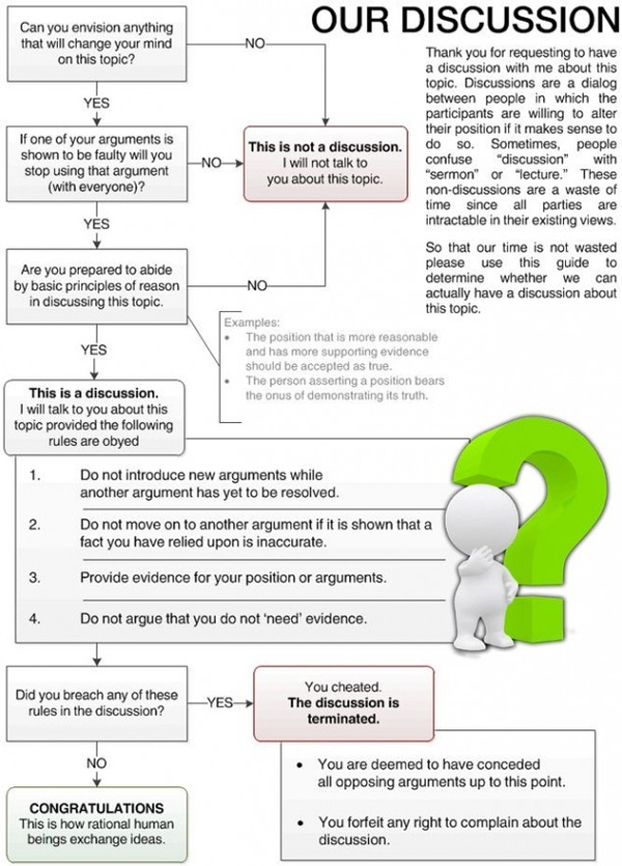
I've run across the attached graphic which provides good rules for discussion. (Possible source.)

Sunday, July 29, 2012

Why do atheists talk about God so much?

I asked a friend to suggest some topics to write about and he suggested this one. I said initially that I didn't think that the topic would take much space, but I'd give it a shot since I need to get writing again.

My friend knows my history, but I tell you why I talk about this stuff so much just for the record. If you happen to have read my blog, you'll remember that I was a Christian for 44 years of my life. I spent years teaching adult Sunday school. I became an elder and lead an adult Bible study in my home. Once I stopped believing, I never quite got over my hobby—thinking about these things.

But why do atheists, in general, talk about God so much? Well there is an assumption that they do talk about God. I have said, somewhat seriously, that I wouldn't mind living in a predominantly atheist country such as Sweden or Norway. But who would I talk to? This is my point. Atheists talk about God and religion because, in this country, religious issues are at the forefront of public life. (For the record, I live in the United States. So that is what I mean by this country.)

Christians, Muslims, and religious Jews inasmuch as they are against LBGT rights are so because “God said so” and to some degree they can point to their particular holy book to indicate this. So the first reason that atheists care about the topic is because it is a major justification that religious people use to assert almost anything.

Consider the following imaginary conversations:

A: Why are you against welfare?
B: Because God said that if you don't work you shouldn't eat. (2 Thess. 3:10)

A: Why do you support welfare?
B: Because God said that true religion is looking after widows and orphans. (James 1:27)

A: Why are you a capitalist?
B: Because it is God's ideal form of economy.

A: Why are you a socialist?
B: Because it is God's ideal form of economy.

A: Why are you a republican?
B: Because Jesus would be a Republican.

A: Why are you a democrat?
B: Because Jesus would be a Democrat.

We could go on. Of course, I don't mean to suggest that all Christians think this way. Some are capitalists because they think that if we more purely capitalist, the problems in our country would largely resolve themselves. That is, they think that it really is a viable form of economy. Some are democrats because they believe that the issues that Democrats concern themselves with are truly the issues that all Americans should concern themselves with.

So an atheist cares about the dialog about God because it has an impact on everyday life. We care because non-atheists (double negative!) think atheists are immoral. In part then, we engage in these conversations because we hope to dispel these perceptions. We care because of the various controversial positions a person could hold or be, it is atheists for whom United State citizens are least likely to vote for—if you can believe it, behind gays and Muslims. It should be noted that as of August 2011, for the first time, more than 50% of Americans would vote for an atheist. But still behind the other positions. Here's US Today article on the Gallop Poll. Here is the link to the Gallup website with those results. For additional amusement, do an internet search for “atheist death threats”. Fox News registered 8000 death threats against atheist shortly after they interviewed the communications director for American Atheists. Here's the link.

I care because I have to be careful to not mention my lack of belief at work. This may or may not be a justified fear, but I had a boss of my boss' boss tell me that “Jesus is the God of second chances.” This seemed to me to almost as out-of-place as suggesting that if I want to get a promotion, I need to attend the boss' Bible study. Almost.

So why do atheists talk about religious stuff? Because we care enough to engage the culture. Both to protect ourselves and also because, like religious folk, we think that our contributions to culture could have a positive impact on our society.

Saturday, April 21, 2012

Is "That was then" a reasonable excuse?

This post is more of a rant, I suppose, then anything else. The subject is this: Is it reasonable for defenders of Old Testament (the Hebrew Bible) to say that God authorized certain behaviors that we reject today because "That was then"? The answer is clearly no.

Let's list some examples:
  1. You could own slaves--as long as it wasn't a fellow Israelite. (Lev. 25:44-46)
  2. But you could own Hebrew slaves (Contradiction!). But you could own him for only 6 years. (Exodus 21:2-6) BUT if you gave him his wife and he had kids, they were to remain slaves FOREVER.
  3. Note that the above doesn't apply to females. They never go free, apparently.
  4. You can sell your daughter into slavery ... and she could never go free. (Ex. 21:7-11) The owner could choose to marry her--presumably against her will. If he takes another wife, that okay as long as he continues to feed and fuck her.
  5. You could beat your slave and if he didn't die after a couple days, that was okay. (Ex. 21:20-21)
  6. If you discovered that your wife wasn't a virgin on your wedding night, you could stone her. Deuteronomy 22:13-21. It should be noted that the text says, "if tokens of her virginity be not found", suggesting what? That's right. Hide the evidence and be freed from an unwanted wife.
  7. Genocide. E.g., Numbers 31.
The Old Testament, as far as I know, doesn't specify how the stoning is carried out. However, according to the Wikipedia article on stoning (link), these were the conditions specified by the Islamic Penal Code:
Article 102 – An adulterous man shall be buried in a ditch up to near his waist and an adulterous woman up to near her chest and then stoned to death.
Article 103 – In case the person sentenced to stoning escapes the ditch in which they are buried, then if the adultery is proven by testimony then they will be returned for the punishment but if it is proven by their own confession then they will not be returned.
Article 104 – The size of the stone used in stoning shall not be too large to kill the convict by one or two throws and at the same time shall not be too small to be called a stone.
Imagine this. No one rock can kill you. Various of your teeth chip. An eye is blackened. Another eye is burst from its socket. Ribs are cracked. Maybe your ear is shredded. An eardrum bursts. Eventually you have a concussion and perhaps nausea sets in. You soil yourself. You vomit. If you are lucky, you become unconscious. If not, you'll probably die in even more pain while you bleed internally.

I think this might be the single most inhumane of killing another being. Christians are fond of saying that crucifixion is the worst. But at least once the nails are in, it's just a matter of waiting.

The point of this post isn't the various evils of the Bible but rather whether any of the above can be justified because of the times in which the original so-called recipients of the law lived.

We are supposed to believe that this horrific law was handed down by a benevolent god. This god is also, traditionally, all-knowing and all-powerful.

How is it then that this all-knowing, all-powerful being cannot make known to his followers a better way of doing things? How is it that we are told that the kosher laws were perhaps given to specify a humane way of killing beasts and yet we cannot have a humane way of killing people, supposing that a death penalty is required at all? Speaking of which, how is it this god who was in more-or-less direct contact with his people couldn't have explained how to carry out justice without a death penalty? Why could not this god make it clear how people could be rehabilitated? How about a method of agriculture that doesn't require slavery? Even supposing that we cannot imagine how, in that society, to pull it off, remember we are talking about a omnipotent, omniscient god.

I've heard this argued before, that God had to allow slavery because of the times. That there had to be stoning because they needed a death penalty.

Given the traditional Abrahamic god, this is patently false. Even allowing a god that too was learning as it went along, that god is unbelievably unimaginative (except in matters of cruelty).

The god of the Old Testament is grossly incompetent, evil, and even stupid.

Sunday, April 15, 2012

Objective Morality? Maybe.


Euthyphro's dilemma is this: "Is what is morally good commanded by God because it is morally good, or is it morally good because it is commanded by God?"

This dilemma is typically posed to theists to illustrate a problem. Namely that if God commands what is good then there is something beyond or outside God—and if we call God good, then God is judged by something beyond him. This places something beyond God and even over God. The other horn of the dilemma is that if whatever God commands is good, then 1) good is arbitrary, and 2) to say that God is good is meaningless—there is nothing by which to judge God. All one can say is that God is God.

What theists say of the atheists is that atheists have no objective standard of morality—their morality is subjective. There are several responses to this accusation. The first is “So?” In other words, the theist must explain why this is a problem. The second is “what makes you think you have an objective standard?” Another is “actually atheist morality is objective.”

In my experience most of these discussions take place without anyone defining their terms. We assume that we know what we mean when we say moral, objective, and subjective. Over the last year or so, I've begun to question both what I mean by these terms and what my interlocutors mean by the terms. The atheist responses to the accusation of subjectivity all are good depending on what we mean by our terms. This is the gist of this post.

Whatever morality's source, even if it is God being arbitrary, we see that morality is that which corresponds to the general welfare of humans. Murder both ends an individual's life and interrupts the harmony of the community. Rape disrupts an individual's sense of security and control over one's body while also violating the community's sense of social contract with respect to sexual mores. (Whether society's sexual mores are good or where they come from is a subject for another day.) Similarly, 99% of the population having food and adequate housing is better than if only 1% of the population is fed or has adequate housing. (Parts of this post borrow from Sam Harris' Moral Landscape.)

A significant question then is what do we mean when we say one state of affairs is better than another. In one sense it is true that we all know it when we see it. (Like pornography.) We just know. We evolved as a social species. The goal of all life is to perpetuate itself. So for whatever reason, our species evolved as a social species because it presented solutions to the problem of survival. Those members of the species that mastered cooperation lived to reproduce. Thus cooperation, morality!, is simply part of who we are. It is, of course, true that certain members of our society do not cooperate. And, we call those people psychopaths or sociopaths. This recognition of the non-cooperative is part of the filter that minimizes that portion of the gene pool from mixing with the rest. Of course, some people are attracted to the sociopath. Why? I don't know. Perhaps, this keeps the gene pool stirred and not stagnant. Too much sameness will kill the species. Too much of a bad element will also kill us.

But while I think the above is correct it doesn't feel personal. It makes me feel good, warm, well, even healthy when I take care of my fellow humans. When I don't do good, I don't feel good. When I do bad, I feel bad. When people do good to me, I encourage that. When people do bad to me, I discourage that. This is personal. It is how an individual of a social species is successful.

So what does it mean to say that something is subjective. Those that find subjectivity bad seem to equate subjectivity with arbitrariness. I think though that the above suggests that morality is that which works. And while this may be an induction, induction is all we have. (You might reread my posts on epistemology, starting here.) But induction doesn't mean arbitrary. Nor does “what works.” We observe the results of our actions and either consciously or unconsciously catalog that behavior as either successful or unsuccessful. However fuzzy our definition of successful, we are making a rational, non-arbitrary categorization.

So what is subjectivity? It is the interpretation of phenomena by a individual. Think of the subject of a sentence. Joe interpreted the evidence. Joe is the subject. Evidence is the object. Joe's interpretation is subjective. The evidence is objective.

An object, as opposed to the subject, is that which is outside of ourselves. Joe may have feelings about an object that you an I do not. The object is the object regardless of how any of us feel about it. You might say then that objectivity is the supposition that we have correctly perceived an object. That is, we have the truth about that object. Objectivity is what is true regardless of our perception. A pebble may in fact lie 3.5 meters to the north of a crater on the dark side of the moon. This is either true or false regardless of whether we are capable of perceiving it.

How you know you have the truth about an object? Going back to my assertions that all knowledge is gained inductively, we also learn how correct we are about our assessments inductively. One mechanism is intersubjectivity. This is the comparison of our subjective experience with others' subjective experiences. If we all agree that a rock is hard, then we have a term that applies to the rock. If we all agree that some other rock is hard, but not as hard as the first rock, then we have a sense that we are all on the same page on the concept of hardness. When we are alone, we evaluate our correctness about some subject based on how correct we are in general in other circumstances. That is, we induce our probability of correctness based on our other experiences in assessing truth. We might ask ourselves, “how correct would others find my assessment?” (Incidentally, I am not suggesting that this is necessarily a conscious process.)

If all humanity agrees that a certain rock is hard, we are as close to knowing an objective truth about that rock as we might ever come. If I have always been successful in assessing the hardness of rocks in the sense that almost always people agree with me when I say a rock is hard, then even when I am alone I have a certain assurance that this other rock that I've never shown to anyone else is also hard.

So if theists claim to have objective morality because they have a god, are they correct? Yes and no. I think in a sense morality is objective whether there is a god or not. I will get back to this below. But saying God's existence objective is a mistake. Returning to Euthyphro's dilemma that I started this piece with, if goodness is outside God then God's perception of that goodness is subjective. (Too, that goodness is available to us with or without God; so the theist's position is no better than a non-theist's. Both sets of perceptions of this objective morality are subjective by definition.) If God declares what is good arbitrarily (the other horn of the dilemma), is that any less subjective? I don't think so. If the apologist avers that goodness is part of God and thus neither outside God nor arbitrary, is God's perception of itself less subjective? I don't think so. Consider your own perception of yourself. Consider how many studies show that our perceptions of ourselves are wrong. Can we suppose that God's perception of himself is perfect? How would we know? If God asserts its perceptions of itself are perfect, how can we know that it knows that? Surely the assessment that it knows perfectly is subjective. Suppose that we all agree that the morality that God asserts is objective, how does this help. Isn't our perception of its decrees subjective? And if I disagree and take my observations from nature and yet come to the same conclusions as a theist, is the theist justified in his assertion that morality is objective because of God's existence? Again, yes and no. But again, the theist is in no better position than the non-theist. We all must perceive that morality whatever its source.

As a side note, the whole question of God and morality is a little bizarre. A theist asserts that morality cannot exist without God and since morality exists, so must God. His problem is that the premise cannot be substantiated. How could one possibly know that morality cannot exist without God. The atheist, on the other hand, could assert that since God doesn't exist and morality does, then obviously the premise is false. As I've worded it here, the atheist and the theist are both guilty of assuming the consequent (begging the question). That is, they both assume what they are trying to show. To be fair, I don't think I've ever seen a non-theist argue this way. (I have, but it was meant ironically.) The other aspect of this is that for all the claims that theists have objective morality I've seen little to substantiate the idea that they live any better lives than non-theists. For that matter, even if God were to exist, I can't see why the behavior of theists as a whole would be more pleasing to that god than the behavior of non-theists.

And so, the atheist's response “why does the theist think his morality is objective” is sort of justified. As I've hinted at, I think there is a sense in which I think morality is objective. But the appeal to a god as a source doesn't make it so.

Referring back to my list of possible atheist responses to the accusation that we have no objective morality, one response was “so”. If in fact subjectivity doesn't mean arbitrariness, then why would it be a problem for morality to not be objective. We observer that humans, whether we presuppose a God given morality or not, don't change their morality as often as they change their underwear. The fact of the matter is that if gods don't exist, our morality is relatively constant. Regardless of belief, theists don't behave any better than do non-theists, nor are their societies more stable. If we define morality as that which improves the condition of mankind, then the so-called objectivity of theist morality is evidently no more effective than that of the so-called relatively subjective morality of a non-theist.

The apparent need for an objective morality is similar to the preference for deductive logic over inductive logic. Deductive logic provides assurance of a correct conclusion given that the premises are correct. Most of us humans make the assumption that our premises are correct. Thus we go through life assuming our conclusion don't just follow but in fact correlate to reality. As I may have mentioned in a previous post, the most dramatic growth occurs when one questions one's premises. This happens both in science (consider quantum mechanics with respect to Newtonian physics) as well as in our individual lives. Deductive logic is invaluable so long as we keep in mind what our fundamental premises are and hold them suspect when necessary.

This need for assurance also can be seen in our persistence in our implicit assumption of platonic ideals. If you have engaged in debates and you are of an atheistic persuasion, you've perhaps encountered someone who thinks you are inconsistent for not believing in gods but yet you believe in love. Our western type dialogs persist in referring to love as it were a concrete substance. And yet that substance does not exist. Love is the name of a certain group of behaviors. Of course behavior exist in a sense. We see actions. That set of actions over there, we call that running. Those over there, that's justice. Those? Hatred. Etc. But none of those things have a substance. They exist only in that they are concepts that help us process our life experiences.

So I wonder sometimes if theists suppose that morality is objective because “thou shalt not murder” is engraved on a rock 3.5 meters to the north of a crater on the dark side of the moon. It is interesting that there is certain contingent of atheists that suggest that this is what is meant by objective. It is then taken as a given that of course morality is subjective.

Sam Harris argued that this is false and I think he may have convinced me. He didn't really undertake to explain his use of the words objective and subjective. (And this is in part is what prompted me to write this post.) But the gist of it is, I think, what I have written above. We all know what morality is. By and large we agree. Sometimes it takes a while to come to new moral sensibility such as women and other ethnicities are people too. We know that a woman running from a rape gang after having watched them force her younger brother to execute the rest of his family only to be slaughter in his turn – this is bad. We know that if every one in the world had adequate food and shelter (which is certainly not true at this writing) this would be better than the condition of the world is now. We know that individual freedom so long as it doesn't impinge on others' freedom is good. We know that the requirement to stifle one's thoughts impedes scientific and moral development.

Intersubjectively, which the best of approximation of objectivity we can hope to have, we know which way is best. Inasmuch as there are cultures that think of women as chattel, we can compare results and know that they are wrong. We can look at Japan and what, to me, is a very weird idea of what qualifies as entertainment and observe that they have less crime by any measure than does the United States. Perhaps the Greeks were right and catharsis is a useful concept. (Look up Hentai sometime—but consider yourself warned.)

Some claim that we need a deity to ensure that we will behave properly. My visceral response to this is that it obviously hasn't worked very well. Slightly more objectively, theist behavior has been no better than a non-theist behavior. Given that this assertion seems baseless, should we consider it more or less moral for one to think that they only can avoid evil if there is a threat of punishment? Is the so-called selfless act morally good if one knows that one's deity will reward them? Surely one who avoid evil because it is evil and does good with no celestial reward in store is more moral. I may be happy if I can come up with a threat that gets my children to clean their rooms. I may be happier if the promise of ice cream will get them to do it. But, I am happier still if they learn and appreciate the value of cleanliness for its own sake.

One more term needs to be mentioned. That is relativity. You might hear those decrying the evil of relative morality. This is meant, I think, to be equivalent to subjective morality. In any case, the fear is that evaluating situations according to context would lead to people doing whatever they want and disregarding society. For one, I don't think the non-sociopath is capable of disregarding society—at least most of the time. For another, the critics don't seem to object to evaluating even murder in its context. We have first degree, second degree, third degree murder as well as manslaughter. (In the U.S., these laws are defined on a state-by-state basis. Most have variations of this list.)

Humans know that one state of affairs is better than another. We know that there is such a thing as too much eating. We know there is such a thing as starvation. We also know that those aren't the only choices—there is a better way. Similarly, we know that treating people as you would be treated (as C.S. Lewis charmingly put it, do as you would be done by) is better than treating people as you would not be treated. One message board I belong to used to claim to have only one rule; don't be a jerk. Morality is not a complicated thing. Humans don't need a deity to get “do as you would be done by.”

God's existence has nothing to do with morality.

Sunday, March 11, 2012

Atheism: My First Four Years


A little more than four years ago, a bolt of lightening came from the sky … No, that's not it. I gave up faith for lent. A funny thing happens when you do that. Nope, that's not how it goes either (though it was the right time of year).

I haven't given many details of my deconversion but I'll save a more conventional “testimony” post for some future date. Suffice it to say that around 4 years ago, near Darwin's 199th birthday, I admitted to myself that I didn't believe anymore.

So, what's it been like? Well, to start, God not striking me dead for my apostasy was quite a relief. Seriously, even though my reasoning took me to this place. I still half expected that God would finally respond to my questioning. That he didn't added confirmation to my position. It was both a relief and a disappointment.

I don't recall much of the March that followed. I think this was when I began making preparations for stepping down from my positions in the church. I had already told the other elders and the pastor that I was going to step down as elder. At the time, I said it was just time. I didn't know myself that I was going to deconvert. But the stress of trying to make reality conform to my beliefs was really wearing. I also turned the home group that met in my house over to the leadership of a friend and fellow elder. (A home group is like a house church or a Bible study.)

I know I didn't tell my spouse until April. I took her out to dinner and told her I had something to tell her. In the moment, I hoped only that she wouldn't run crying from the restaurant. As we drove home, she said she was happy that I could confide in her and I, in turn, was grateful simply that she was willing to stay with me.

As an elder in the church I felt it my responsibility to tell those church folks closest to me personally. But I still needed to tell my kids first. So I made plans to tell them and then quickly tell some people outside the family that they could talk to. I told the kids my plan and also how I expected them to handle the news. This went reasonably well.

I told the pastor who appreciated my honesty and my integrity. I then told the people in the Bible study that I ran in my home. I went to individual members of the home group and spoke with them about it. It was my intention to continue participating in home group. Then a blow came. They decided that they needed to take a vote to decide if I could continue coming. I do understand. My deconversion came as quite a shock. At least one wondered to whom they would go for the hard questions now that I wasn't a Christian (as if I suddenly knew less than I did before—but I did understand). Eventually, they voted in favor of me continuing. I then did continue for a few months. In time, the awkwardness proved too much. I would usually step out during prayer time just because I didn't want to listen to it. I would contribute my two cents to the study. After these contributions I let the new leader acknowledge or modify what I said without comment. It didn't seem fair to dominate the conversation as when I was the leader. So I always let the leader have the last word. But, I came to feel as if they were humoring me when I spoke. This wasn't mean, I think. I would contribute what I knew about some passage while everyone would remain silent as I spoke, not in the he's-one-of-us silence but the let's-be-polite silence. So I stopped going.

Around the same time, I stopped going to church. My spouse was (and still is) very involved church and so much of the church service, I was by myself, sitting there, feeling like a spectacle. Mind you, no one went out of their way to make me feel that way. But you had to wonder what they were thinking. “Better put on a good show for the atheist.” “If we pray hard enough, perhaps he'll come around.” “Poor [spouse].” “Gee, this is awkward.”

I didn't sing the songs. I didn't bow my head to pray. I did, however, stand when they stood and sat when they sat. I had always been critical of what a speaker said and now what was said was almost intolerably inane. (I am speaking more of my feelings than I am of actual sermon content.) So then this too ended.

That Christmas, I came clean with my in-laws. I had made the decision that I wouldn't tell my parents. Both my in-laws and my parents live a very long way from us. But my parents are along in years and so it seems probable I can let them die in peace, untroubled by this news. So far this has been workable. My in-laws, on the other hand, most likely live another twenty or thirty years. So I spoke to my father-in-law. It was almost as hard as asking for his daughter's hand in marriage. In any case, I used the term non-theist somewhere along the way. It turned out to be a good spur-of-the-moment decision. As many do, he seemed to associate atheism with all the evil in the world. He was glad I wasn't one of those. I think in the intervening years I've become more casual in my terms and, I think, he's become less inclined to broad-brush all atheists.

The remaining three years were considerably less interesting. I'd revealed myself to whoever I had planned to so there wasn't that to deal with any more. Along the way, I went to see a boss several levels above me. The conversation swung in such a way that he said something about Jesus being the God of second chances. I just had to nod. (I think that my religious thought was perhaps well known. At some point, a transgendered friend said that it was probably more shocking that I became an atheist than he becoming a she.) Another boss, asked if I had seen the movie Expelled. I simply said that I had read some reviews and that the movie didn't seem like it would interest me. Largely, my work life in uneventful. There are some who had been my friends before and during my adventure. They've continued to be my friends. By and large, I keep my thoughts to myself. I just haven't felt that outspokenness on atheism wouldn't be advantageous to my career. I never had to think about that when I considered myself a Christian.

My attitudes have changed somewhat. Originally, I was just relieved for myself. Over time, I've felt a trend to disdain. This is something I don't like in myself. The positive thing, I suppose, is that my position has become clearer to me. I am increasingly convinced that religion is dangerous for mankind. I don't know what to do about that. I don't know that there is anything to do about that. Perhaps humans must simply grow out of it. Unfortunately, that terminology sounds a little condescending. I prefer to think that it merely sounds right. After all, one hopes that a thinking person holds the positions they do because they think they are right. And so, I hope that even those that disagree with me do so for careful consideration. Dumb opponents are more dangerous than intelligent ones—at least in philosophical discussions.

Nevertheless, how could I possibly consider myself superior. After all, it took 44 years for me to come to where I am and have been for four years. All people are different. I consider my spouse in all ways my intellectual equal and perhaps in some respects my superior. I don't imagine, though, that there will ever come a time in her life when she will allow herself to consider that god may not exist. We've been through some dramatic upheaval that I won't relate here. While for me that event just confirms god's non-existence—or at least his disinterest—for her, it is just another of those trials that serve to test one's faith and make us stronger. Some of my atheist friends have been atheist all their lives. Some became atheists at less than half my age of deconversion. If I had lived my life differently, if I, say, had become a missionary to China as my spouse and I once thought we might, perhaps that commitment would have overwhelmed my doubts and I'd be as dogmatic as any television preacher seems to be.

I don't miss prayer. I don't miss the idea of a god watching over me. I don't miss a sense of relying on a god who never answered my prayers anyway. Solutions in my life come as they always have, through my friends and family and, more rarely, my own ingenuity.

I do miss some friends. Friends are a weird thing. Those people I hung out with outside of church, at work or the pub, I still hang out with. Those that I knew through church, I hardly see anymore. That is disappointing. I considered them just as real as my other friends and perhaps they were. But when the your natural association is removed, it seems your friends disappear. I supose some of them would still call themselves my friends and I am honored by that. However, by a more rigorous definition, they are acquaintances. I've never been good at maintaining contact with friends after we've moved, which we've done a few times. So, there is a strong measure that out-of-sight-out-of-mind is how I operate. When I see those friends from church, it has some of the same awkwardness I described about attending church.

In the meantime, my kids don't really talk to me about my unbelief. Well, except as noted in a previous post where my daughter called to confess her imperfections, which of course was more about her than me. Also, my youngest expressed some concern that it was her fault which, of course, I told her it wasn't. Over four years, that ain't much. My spouse and I talk about it but mostly obliquely. If we talk about religion or ir-religion, we do so as disinterestedly as possible. That is, we avoid offending each other. All-in-all, I think that given that my personal stress levels are down from no longer having to solve all the worlds philosophical problems, I think I am a better father and husband even though my atheism is a sticking point.

So what will future years bring? Who knows. I have told people that it took 44 years to get to this point. It might take another 44 to come to some other conclusion. In all honestly, I don't think it is likely.

I think I have some goals along the lines of rereading some of my theology books and maybe even rereading the Bible. I would like to read more books about brain function and morality.

But all-in-all, I want to stay happy and maintain my integrity.